%20--%3e%3csvg%20version='1.1'%20id='Layer_1'%20xmlns='http://www.w3.org/2000/svg'%20xmlns:xlink='http://www.w3.org/1999/xlink'%20x='0px'%20y='0px'%20viewBox='0%200%201080%201080'%20style='enable-background:new%200%200%201080%201080;'%20xml:space='preserve'%3e%3cstyle%20type='text/css'%3e%20.st0{fill:%233A6D9E;}%20.st1{fill:%23FFFFFF;}%20.st2{fill:%230F2942;}%20.st3{fill:%234A8AC2;}%20.st4{fill:%236AA8D4;}%20%3c/style%3e%3cg%3e%3cg%3e%3cg%3e%3cg%3e%3cg%3e%3cpath%20class='st0'%20d='M532.3,384.4l-27.5,14.5c-0.2,8.4-1.4,29.2-7.8,50.4l42.7-22.5c0.2-3.5,0.3-6.8,0.4-10.1%20c0.5-14,0.6-25.7,0.6-32.3H532.3z%20M589.9,406.6h-11.6c0.2,12.1,1.4,23.1,3.7,33c0.9,3.8,1.9,7.4,3.1,10.8l168.8,88.9L540,658.8%20L420.4,592l-0.9-0.5l-93.3-52.2l153.2-80.7c1.7-4,3.1-8.1,4.2-11.9c4.6-15.4,6.4-30.6,7-40.4L240,538.4L540,706l300-167.7%20L589.9,406.6z'/%3e%3c/g%3e%3c/g%3e%3cg%3e%3cg%3e%3cpath%20class='st2'%20d='M504.8,398.9c-0.2,8.4-1.4,29.2-7.8,50.4l-17.6,9.3c1.7-4,3.1-8.1,4.2-11.9c4.6-15.4,6.4-30.6,7-40.4%20L504.8,398.9z'/%3e%3c/g%3e%3c/g%3e%3c/g%3e%3cg%3e%3cg%3e%3cg%3e%3cpath%20class='st3'%20d='M793.4,583.3l-42.7,23.8l3.2,1.7L540,728.3L326.2,608.8l3.2-1.7l-42.7-23.8L240,607.9l300,167.7l300-167.7%20L793.4,583.3z'/%3e%3c/g%3e%3c/g%3e%3c/g%3e%3cg%3e%3cg%3e%3cg%3e%3cpath%20class='st4'%20d='M793.4,652.8l-42.7,23.9l3.2,1.7L540,797.9L326.2,678.4l3.2-1.7l-42.7-23.8L240,677.4l300,167.7l300-167.7%20L793.4,652.8z'/%3e%3c/g%3e%3c/g%3e%3c/g%3e%3cg%3e%3cg%3e%3cpath%20class='st2'%20d='M629.6,552.6c0,0,16.7-7.8,12.4-21c-3-9.3-42.3-12.7-63.8-63c-4-9.4-7.4-20.4-9.8-33.3%20c-2.1-11.4-3.5-24.3-3.9-39c0-1-0.1-2.1-0.1-3.1c0-1.9,0-3.9,0-5.9c0-3.1,0-6.2,0.1-9.4h31.3v-14.3l-32.3-33%20c14.1-9.3,23.4-25.3,23.4-43.5c0-28.8-23.3-52.1-52.1-52.1c-28.8,0-52.1,23.3-52.1,52.1c0,17.6,8.7,33.2,22.1,42.7l-32.4,32.4%20v15h32.4c0,0,0,1.8,0,4.9c-0.1,3.9-0.3,9.9-0.9,17.3c-1,12.5-2.9,28.9-6.9,45.5c-0.4,1.7-0.9,3.4-1.3,5.1%20c-2.5,9.3-5.6,18.4-9.6,26.9c-8.1,17.3-19.8,31.6-36.5,37.7c-33.2,12.6-22.1,31.6-11.1,36.3l-19,14.2v4.2L460,592h57.2v-26.8%20l4.9-12.6h50l7,11.8v26.9h42.1l28.6-16v-10.9L629.6,552.6z%20M543.4,291.3c2.4-10.9,10.4-18.4,17.9-16.8%20c7.4,1.7,11.5,11.9,9.1,22.8c-2.4,10.9-10.4,18.5-17.9,16.8C545,312.4,541,302.2,543.4,291.3z%20M538.2,339.5l0-0.4l0.1-1.1%20l0.8-7.2h11.1l2.1,5.3l4.4,10.8l6.9,17h-32.1L538.2,339.5z%20M518.8,531.1c11.4-11.9,16.9-47.8,19.5-81.8c0.6-7.7,1-15.3,1.4-22.5%20c0.2-3.5,0.3-6.8,0.4-10.1c0.5-14,0.6-25.7,0.6-32.3c0-3.8,0-6,0-6c-0.4-0.4,9.4,0,9.4,0c0,2.5,0.1,4.9,0.1,7.3%20c0.2,14.2,0.8,27,1.5,38.6c0.2,3,0.4,6,0.6,8.9c0.2,2.9,0.5,5.7,0.7,8.5c7.1,75,24.4,89.5,24.4,89.5H518.8z'/%3e%3c/g%3e%3c/g%3e%3cg%3e%3cpolygon%20class='st2'%20points='649.8,575.3%20619.8,591.3%20539.5,634.1%20460,592%20517.2,580.8%20517.5,580.7%20517.5,607.1%20542.5,619%20579.1,599.7%20579.1,568.6%20592.6,566%20'/%3e%3c/g%3e%3c/g%3e%3c/g%3e%3c/svg%3e) Chessstack
ChessstackChess Opening Repertoire Builder and Trainer
Build your chess opening repertoire from masters games, engine analysis and real opponent statistics, then memorize your openings with spaced repetition drills so you never forget your preparation again.
Opening study shouldn't feel like guesswork
- You study a line, then forget it a week later
- You don't know which lines to study next
- You can't tell where your repertoire has holes
- You have no idea if you're actually following your prep in games
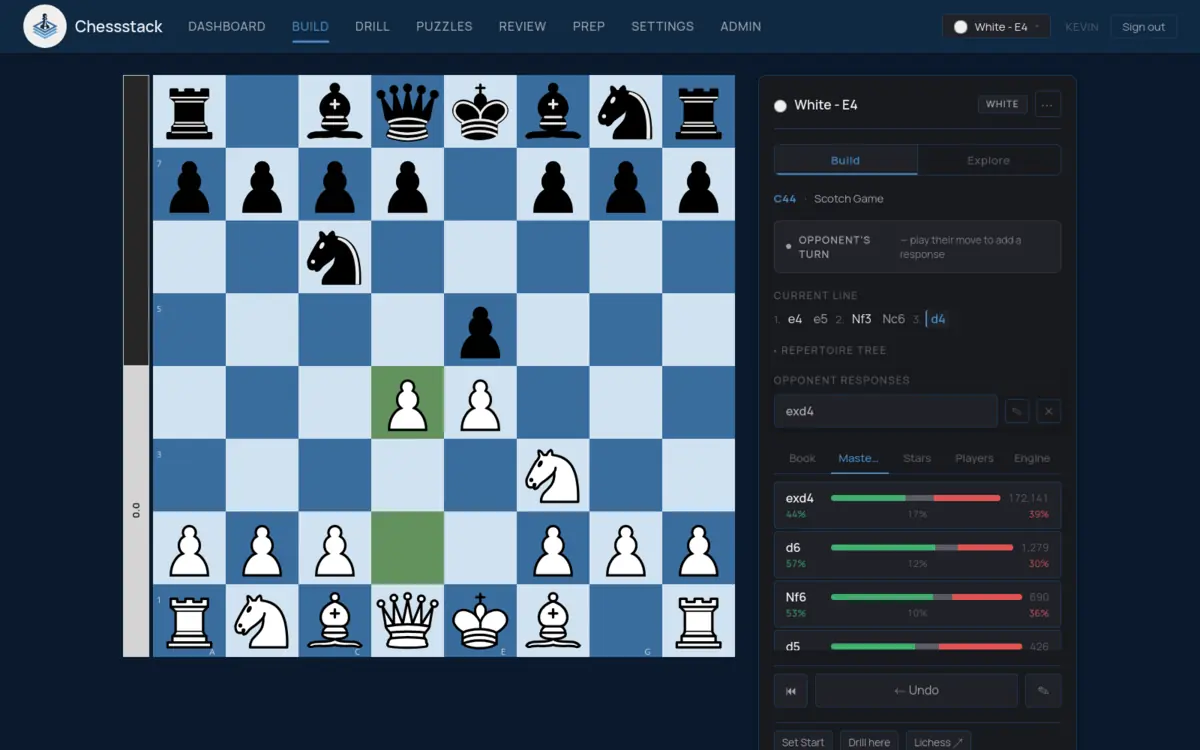
Build your chess repertoire with real data behind every move
Build your opening repertoire move by move with five sources of move suggestions: a 21-million-game masters database, Stockfish engine evaluation, popular moves by rating bracket so you see what opponents actually play at your level, and a curated celebrity database featuring games from chess legends like Bobby Fischer, super GMs like Magnus Carlsen, and content creators like Daniel Naroditsky and GothamChess. Or import your existing repertoire from PGN files. No pre-made courses. Your repertoire, your choices.
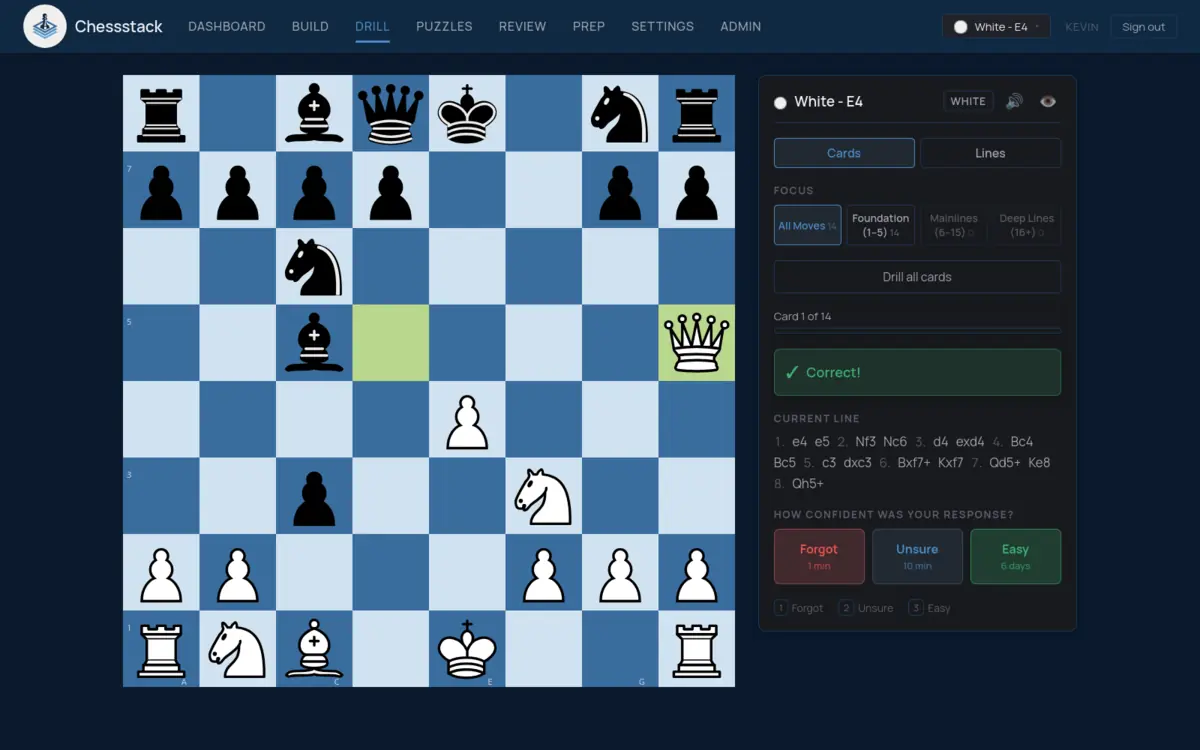
Memorize chess openings with spaced repetition
The FSRS spaced repetition algorithm schedules your reviews at scientifically optimal intervals. Lines you struggle with come back sooner. Lines you know well fade into the background. No wasted repetition, no forgotten variations.
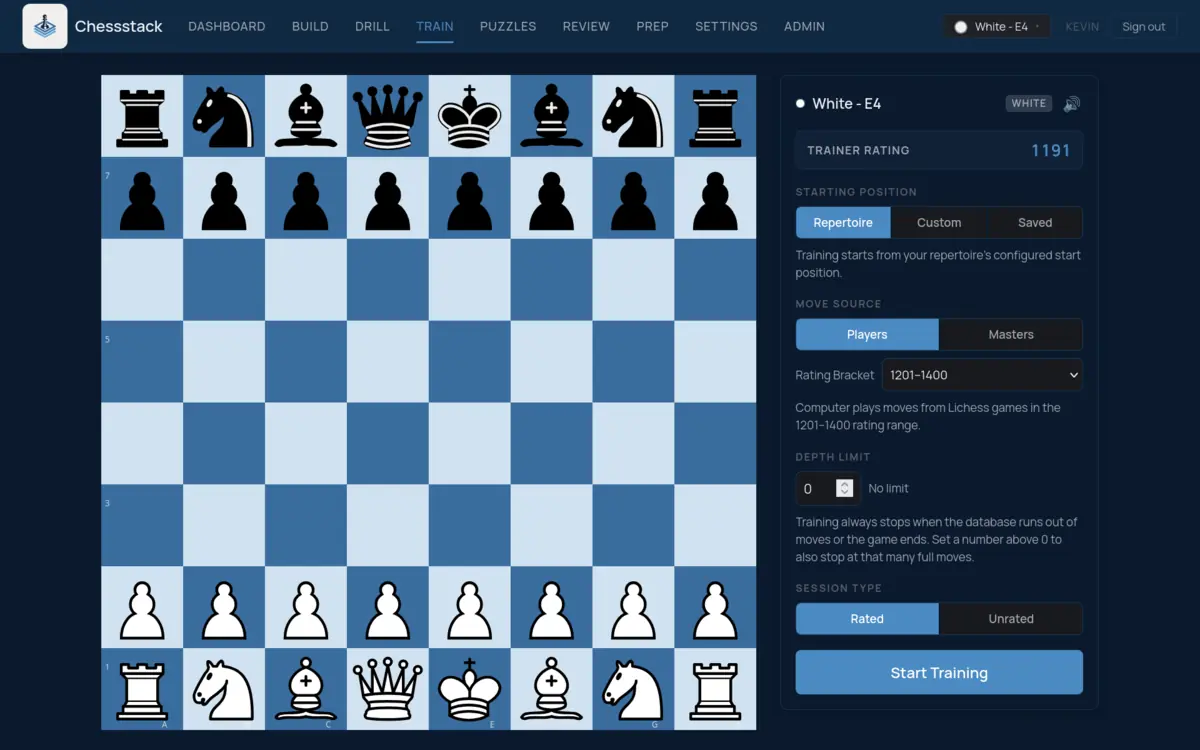
Practice your openings against an opponent that plays like a real human
Play against a computer that mirrors how real people play your openings. Each move is weighted by how often it appears in the Lichess masters database or at any rating bracket. If a move shows up in 40% of games, the computer plays it 40% of the time. Choose any starting position, set a depth limit, and play through your lines as many times as you want. Rated sessions track your Elo so you can measure real progress. When a session ends, review the game to spot gaps and build on your repertoire.
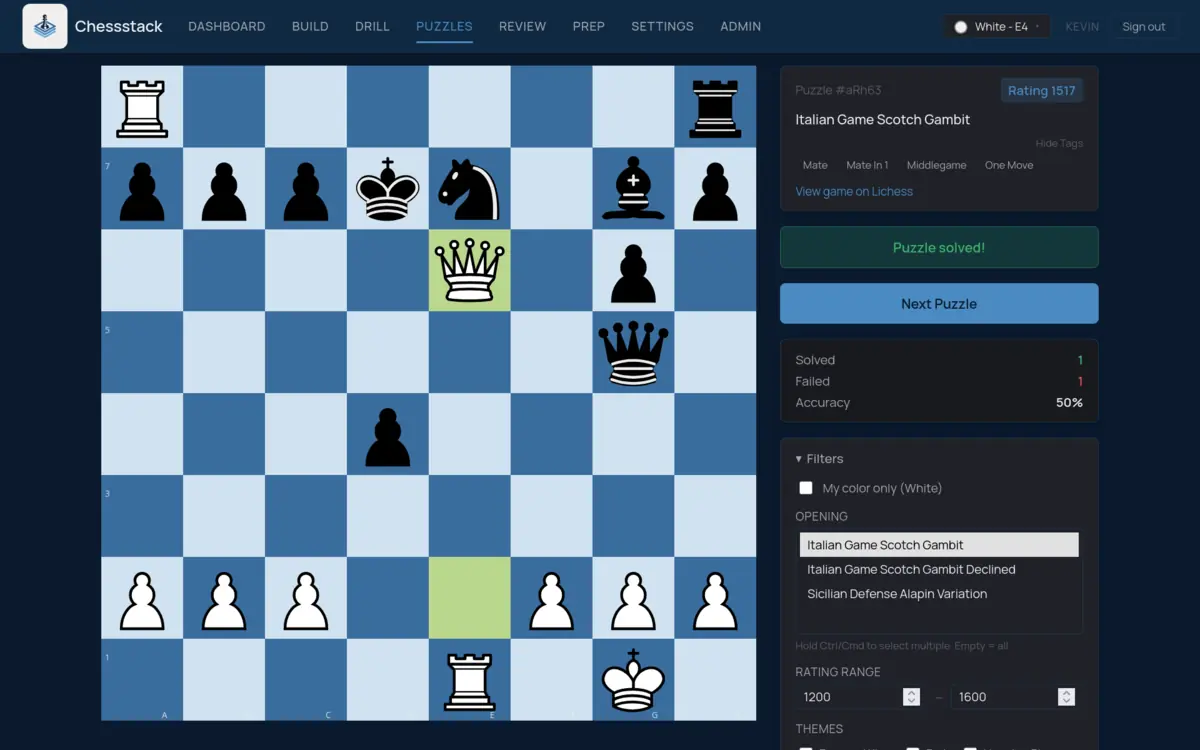
Tactics puzzles from the openings you actually play
Solve tactical puzzles filtered to your opening repertoire. Practice the combinations and patterns that show up in your games, not random positions you'll never see. Every puzzle links to the real game it came from so you can see the full context.
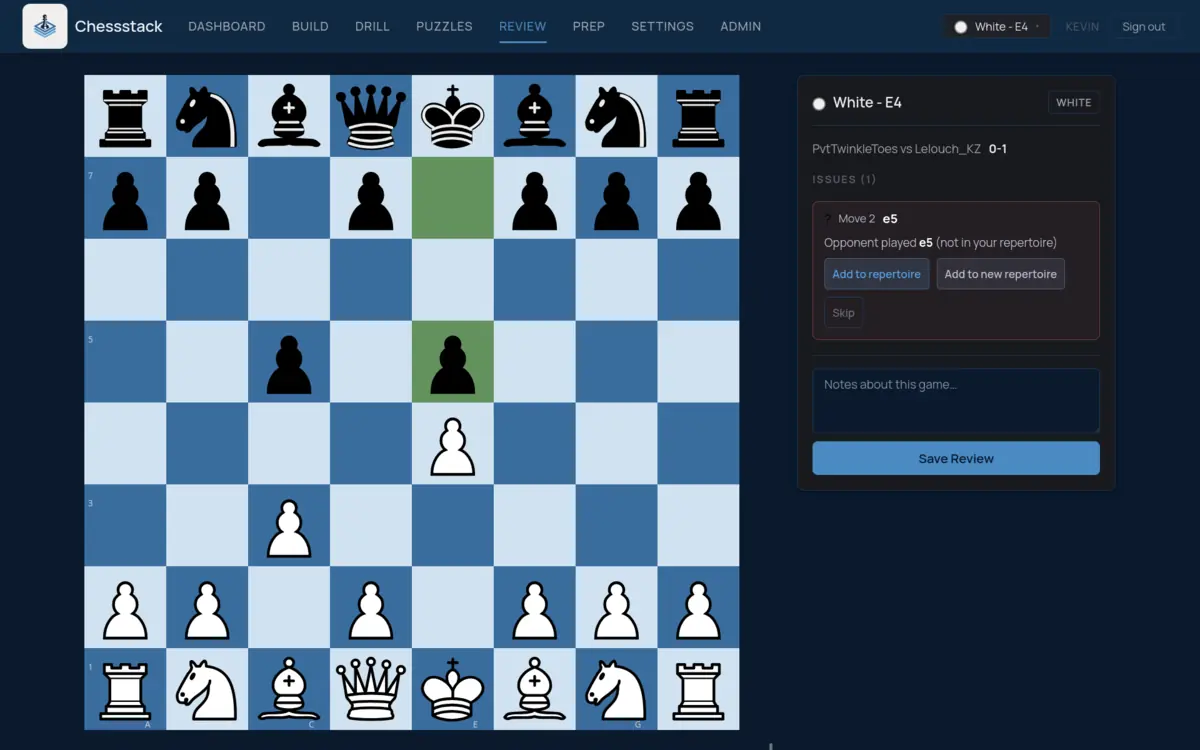
Check your games against your repertoire
Import your games from Lichess or Chess.com. Chessstack highlights every move where you or your opponent deviated from your repertoire, so you know exactly what to study next instead of guessing.
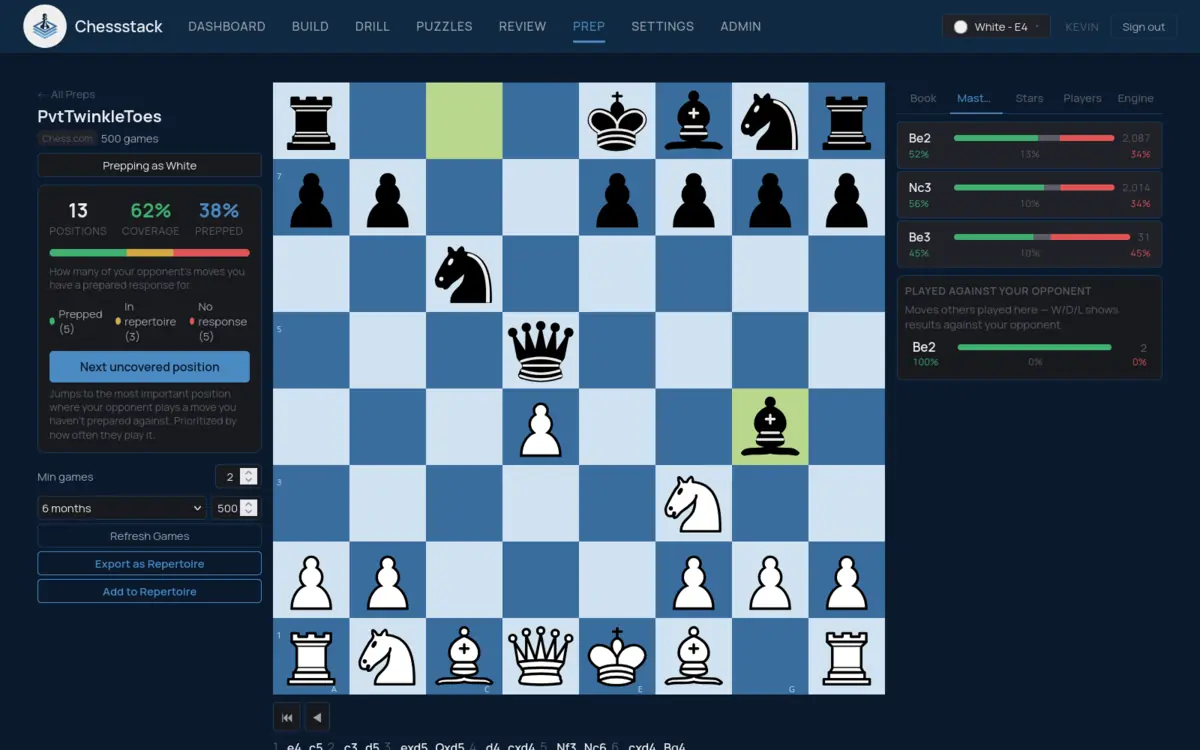
Prepare for any opponent's openings
Enter any player's Chess.com or Lichess username and download their game history. Chessstack compares your repertoire to the lines they actually play, so you can build targeted lines or even a full repertoire against them and practice it in drill mode.
Open-source chess opening trainer. Self-host for free, or use the cloud.
Chessstack is fully open-source. Self-host it on your own machine with a single Docker command and get every feature with no limits, no subscriptions, and no data leaving your network. Prefer not to manage infrastructure? Use chessstack.app free with one opening repertoire, or upgrade to unlimited repertoires for $1/month or $10/year.
Frequently Asked Questions
What is a chess opening repertoire?
A chess opening repertoire is a set of pre-planned responses for the opening phase of a chess game. A complete repertoire covers both colors and includes responses to all common opponent moves, so you always know what to play in the first 10-15 moves of a game.
Why should I learn chess openings?
Studying openings helps you steer games toward positions you understand, save time on the clock in the early moves, and avoid falling into traps or lost positions before the middlegame even starts.
What is spaced repetition, and how does it help with chess?
Spaced repetition is a memory technique that schedules reviews at increasing intervals. When you get a move right, you see it less often. When you get it wrong, it comes back sooner. Applied to chess openings, it lets you memorize hundreds of lines without wasting time on the ones you already know.
How many opening lines do I need to know?
It depends on your level, but a focused repertoire of key lines beats memorizing everything. Start with responses to your opponent's most common moves and build depth over time. Quality matters more than quantity.
Should I study openings as a beginner?
A common misconception is that beginners shouldn't study openings. The hardest part of chess to learn is the middlegame, and it's hard to learn the middlegame if you keep entering it in a lost position. Even a simple repertoire helps you reach playable positions so you can focus on improving the rest of your game.
Can I use my own openings, or do I have to follow a course?
Chessstack lets you build your own repertoire move-by-move, and you can also import PGN files from other sources. The build tools (masters database, engine analysis, rating bracket stats, celebrity games) make it easy to find and add the right moves yourself.
How do I know if my opening preparation is working?
Import your games from Lichess or Chess.com and see exactly where you or your opponent deviated from your repertoire. Track your mastery percentage and gap coverage over time to measure your progress.
How much does Chessstack cost?
Chessstack is free with one opening repertoire. For unlimited repertoires, upgrade for $1/month or $10/year. You can also self-host the open-source version for free, with no limits.
Opening study guides
How to Memorize Chess Openings (Without Losing Your Mind)
Why rote repetition fails for chess openings, how spaced repetition actually works, and a practical system for memorizing your opening repertoire.
How to Build a Chess Opening Repertoire
Build an opening repertoire that fits your style: cover the most common replies first, use real game data, and learn how many moves deep to go for your rating.
Why Spaced Repetition Works for Chess Openings
The science behind spaced repetition and why chess opening lines are a perfect fit for SRS algorithms like FSRS.
Popular chess openings
- Alekhine Defense
- Benko Gambit
- Benoni Defense
- Bird Opening
- Bogo-Indian Defense
- Caro-Kann Defense
- Catalan Opening
- Dutch Defense
- English Opening
- French Defense
- Grünfeld Defense
- Italian Game
- King's Gambit
- King's Indian Defense
- London System
- Modern Defense
- Nimzo-Indian Defense
- Petrov's Defense
- Philidor Defense
- Pirc Defense
- Queen's Gambit
- Queen's Indian Defense
- Réti Opening
- Ruy Lopez
- Scandinavian Defense
- Scotch Game
- Sicilian Defense
- Slav Defense
- Trompowsky Attack
- Vienna Game